Kicking Off Our Series on Sustainability in Product Development
Sustainability is now a topic of conversation everywhere. Nevertheless, it often remains unclear what exactly constitutes a sustainable product, process, or project—and where greenwashing begins. Even for a development service provider like us, this is tricky territory, because while many promises can be made, very few of them can be significantly influenced by a single company or service provider. So it’s time to approach the topic differently. We don’t gloss over any supply chain issues, and we don’t make a product sustainable simply by slapping another label on it. What we do in sustainable product development is concrete and, for us, begins with the idea.
The 17 Sustainable Development Goals
of the UN
The United Nations has formulated 17 Sustainable Development Goals, ranging from clean water to affordable energy. As a global framework, these SDGs make sense, but do they make sense for us? A development partner of our size has no influence over food security or educational equity. What we can influence lies primarily in product development and concerns material use, energy consumption, service life, repairability, and recyclability.
That is why we discussed the 17 goals internally and asked ourselves, for each one, whether we—as a development service provider—can actually make a difference there. The discussion showed that we want to consciously focus on the few areas where our work in product development actually makes a difference and where we already have experience. We leave the rest where they are better addressed—with policymakers, manufacturers, and supply chains. For us, sustainability thus has few but clearly defined guiding principles. It is the prerequisite for ultimately producing robust conclusions and truly sustainable product improvements.
Effective Approaches in the Development of Medical and Device Technology
The greatest leverage for sustainable products lies at the very beginning of the entire concept. According to the European Commission, up to 80% of a product’s future environmental impact is determined during the development phase. Whether a device will later be disassemblable, repairable, and resource-efficient is therefore decided during the process of defining materials, device design, and interfaces. Eco-design can only function effectively and minimize costs if it is incorporated from the very beginning.
Furthermore, sustainability is rarely the responsibility of a single discipline. Repairable hardware is of little use if the software blocks access, and an energy-efficient enclosure design is of no help if the electronics
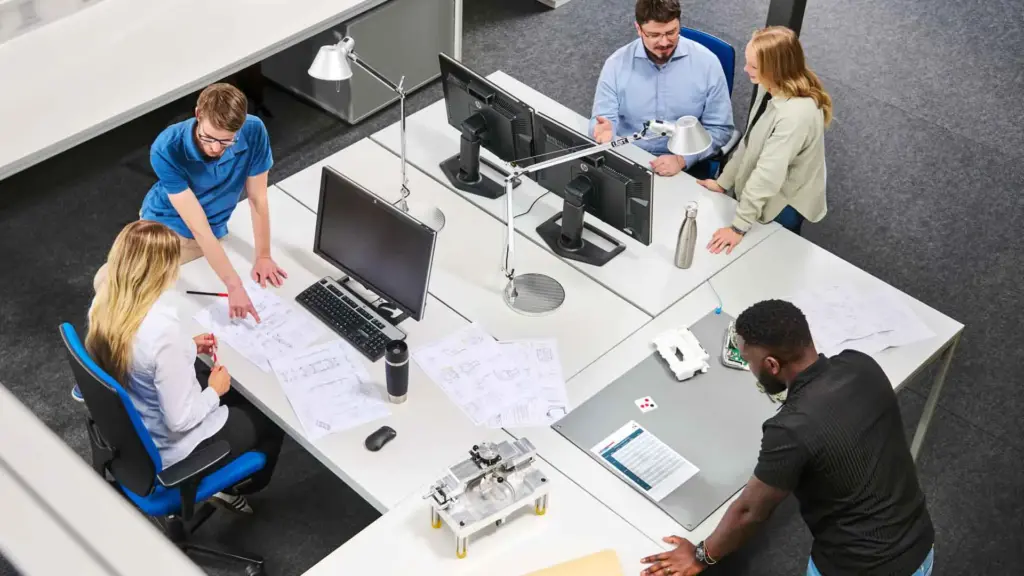
That’s the deciding factor. Because we develop mechanics, electronics, and software all under one roof, we can resolve such interactions early on. Modular platform development tailored to the product’s benefits is a good example of a sustainable development approach. Another key factor is simulation. Using digital twins and virtual testing, we evaluate different variants to shorten the development cycle and conserve resources before any materials or energy are invested in physical prototypes. And finally, much of this is not new territory for us. Battery integration, durable design, and the selection of materials that meet standards have been part of our work for years. The focus on sustainability has always been there; it just wasn’t always called that.
Requirements to Keep in Mind
Anyone writing about sustainability should also address its limitations; otherwise, it comes across as just another overused buzzword—something we want to avoid. The first point is conflicting goals. In medical technology, for example, reparability can very quickly clash with hygiene and sterilization requirements, and a material that is easily recyclable must still meet standards and be approved—or at least eligible for approval. Such conflicts can be carefully weighed, but they cannot be dismissed. This ties into the second point: our sphere of influence. We design the product, but we do not make the decisions alone. You determine the production materials, the manufacturing location, and subsequent operation. We create favorable conditions and also provide support during the market launch, but the final decision always rests with you.
We must also not forget the regulatory landscape, which is currently evolving rapidly. The right to repair, which takes effect on July 31, 2026, initially applies to consumer goods such as washing machines, refrigerators, and smartphones, but not, for example, to medical and medical device technology. The broader framework is the EU Ecodesign Regulation (ESPR), which is gradually making the circular economy, reparability, and a digital product passport mandatory for nearly all product groups. Industrial and electronic products will be phased in under the 2025–2030 Work Plan. For medical technology, a timeline for inclusion has not yet been set, but it is possible in principle.
If a product is intended to remain on the market for several years, it is important to take the provisions of the regulation into account now and incorporate them into the development process.
Sustainability is increasingly becoming something that must be substantiated. This is particularly true in light of the EU’s stricter stance against sweeping environmental claims made without evidence. It is therefore becoming even more important to incorporate sustainability early on and to use the term less loosely. — Sven Dörhage
Without measurability, sustainability remains nothing more than a claim. “More sustainable” is not a meaningful statement unless it’s clear how it’s being measured. For us, a transparent assessment is therefore an integral part of the process and one of the reasons why we’d like to help you better understand this topic in this blog series.
This first post serves as an introduction. The second part will focus on the 9R model—the framework behind “circular design”—and, using “repair” as an example, we’ll show how this translates into current law through the right to repair.
Progressive product development.
Made in Germany.