
More info

B&W ENGINEERING

gets teams drawing-ready

Apply ISO 8015 with confidence.

From spring 2026, Germany’s PAL examination and teaching materials development body uses ISO GPS based on DIN EN ISO 8015 in practical intermediate and final examinations. This dimensioning approach is therefore becoming part of industrial practice. We help development, manufacturing and quality assurance teams prepare through focused training and a compact ISO GPS checklist.

What is changing

ISO GPS is becoming the basis for examination documents, drawings and tasks. Clear specifications are expected in technical communication; ISO GPS provides an international standard and a shared language.

The good news is that practical examinations can retain their familiar format. Two-point measurement remains possible, conventional measuring equipment is still permitted, and theoretically exact dimensions (TEDs) continue to be used.

Our training

We make ISO 8015 / ISO GPS understandable, practical and applicable to your everyday work, using your own parts and drawings. The result is a shared language across design, manufacturing, quality assurance and vocational training, with the examination standards introduced in spring 2026 in mind.

Who is it for?

Skilled professionals, master craftspeople, trainers and examiners in metalworking, mechatronics and manufacturing occupations.

Formats

Workshops, live online sessions or compact in-person training. An optional review of your drawings and examination documents can be included.

Outcomes

Confident application of the core rules, unambiguous drawing specifications, fewer clarification requests and greater confidence in examinations and day-to-day operations.

Course outline

  • ISO 8015 & ISO GPS fundamentals: principles, rules and terminology
  • Drawing sheets and title blocks: DIN EN ISO 5457 / 7200
  • Geometrical tolerancing to ISO 1101
  • Datum systems: definition to DIN EN ISO 5459 and constraining degrees of freedom
  • General tolerances: application of ISO 22081 where individual specifications are absent
  • Modifiers and the envelope requirement: n× and E in the context of ISO 14405-1
  • Practical examination methods: two-point measurement, conventional measuring equipment and partial linear sizes
  • Applying the knowledge: example tasks and avoiding common errors

Your trainer Martin Fischbach

Martin leads our ISO 8015 / ISO GPS training. His approach combines clear examples, step-by-step explanations and knowledge you can apply directly.

BW ISO 8015 2026 01 21 Seite 1 -

Download

Free download

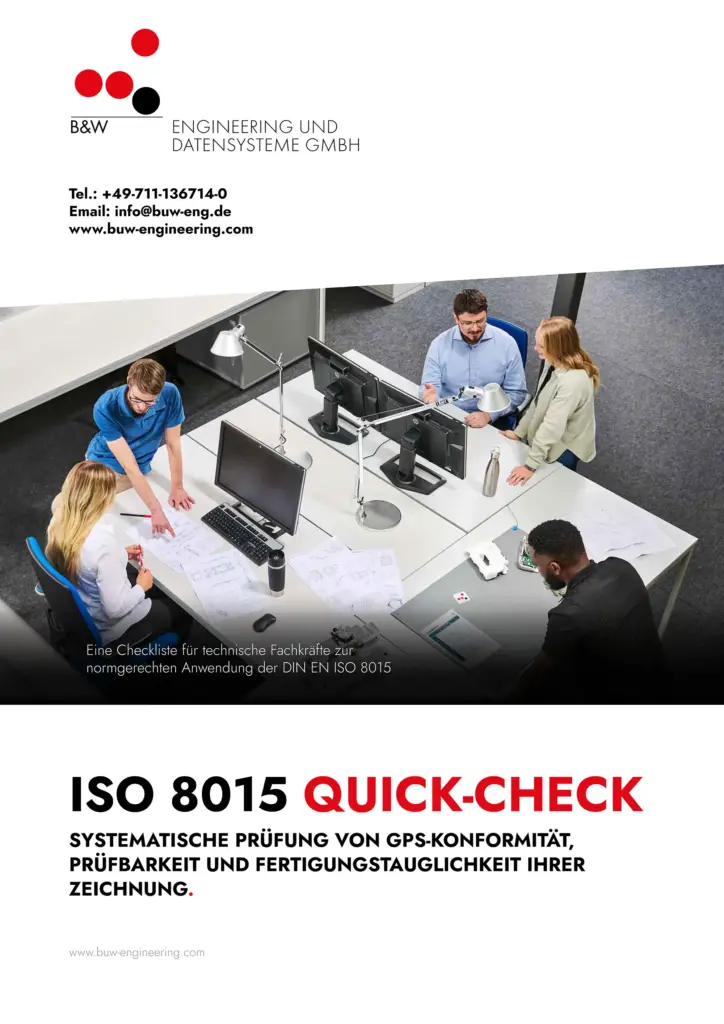
ISO GPS examination checklist

Our checklist brings together the key points to consider from spring 2026. It is designed for development, manufacturing and quality teams, trainers and apprentices.

The checklist is provided in German.

Checklist contents:

  • Relevance: ISO GPS as the examination basis from spring 2026 (DIN EN ISO 8015)
  • Drawings: sheets and title blocks to DIN EN ISO 5457 / 7200
  • Datum systems: minimum number, sequence and tolerance indicators with additional constraints
  • Dimensions without individual specifications: general tolerances to ISO 22081
  • Modifiers: using n× correctly
  • The envelope requirement E: where an envelope requirement applies
  • Examination practice: two-point measurement, permitted equipment and checking the role of theoretically exact dimensions (TEDs)
  • Practical application: partial linear sizes and where they can be measured directly
  • Team responsibilities: who checks what, and who approves?
  • Next steps: training dates, internal communication and document updates
Download the checklist in German

Put it into practice

  • Help your team understand and confidently apply the rules, symbols and drawing annotations
  • Establish clear technical communication
  • Interpret drawings and CAD data consistently and in line with the standards
  • Integrate the requirements into everyday work
  • Use your existing measuring equipment and processes

Contact Martin Fischbach to discuss your requirements.

Martin scaled 1 -
‘For me, it is particularly important that we develop responsibly. In medical technology, the best basis for quality is to stand behind one's own development. In my role as division manager, I can also communicate this way of thinking to customers and within the team.’
Martin Fischbach
Head of Medical Technology
martin.fischbach[at]buw-eng.de
+49(0)661-291906-76