The Prognos study “Efficiency Potential of Innovations for the Healthcare Sector” estimates the annual savings potential resulting from innovations in the industrial healthcare sector at over 20.8 billion euros in the statutory health insurance system. Approximately 9 billion euros of this amount is attributable to medical technology. We’ll briefly outline for you the resulting requirements for engineering, verification, and industrialization.
Efficiency in the healthcare system is achieved when medical devices function properly in hospitals, during outpatient procedures, and for home use.
Efficiency in the healthcare system is achieved when medical devices function properly in hospitals, during outpatient procedures, and for home use.
Prognos estimates that innovations in the industrial healthcare sector currently offer annual savings potential of over 20.8 billion euros in the statutory health insurance (GKV) system. About 9 billion euros of this amount is attributable to medical technology. A particularly significant driver of savings lies in the shift toward outpatient care, for which the study cites a potential of 6.02 billion euros per year. In the “Priority for Innovation and Digitalization” scenario, statutory health insurance benefit expenditures rise to 616 billion euros by 2045, rather than 663 billion euros in the reference scenario. The premium rate would then be 18.7 percent instead of 20.1 percent. These figures are based on specific technical decisions.
A medical device doesn’t save money just because it’s new.
It proves its value when it works in a clinical setting, can be operated properly, can be reliably tested, has been designed with regulatory compliance in mind, and remains stable in mass production.
- In a hospital, every action counts.
- In a hospital, every action counts.
- In an outpatient setting, every minute counts—without any additional uncertainty.
The shift toward outpatient care clearly illustrates this connection. A procedure moves from an inpatient to an outpatient setting when the technology reliably supports this change in location. Devices must be ready for use more quickly, require less infrastructure, provide feedback, and function even in confined spaces.
Minimally invasive instruments require precise mechanics, high-quality imaging, reliable electronics, professional software logic, and user-friendly operation. Sterilizability, material selection, tolerance chains, reprocessing, documentation, and serviceability determine whether an idea makes it into clinical practice.
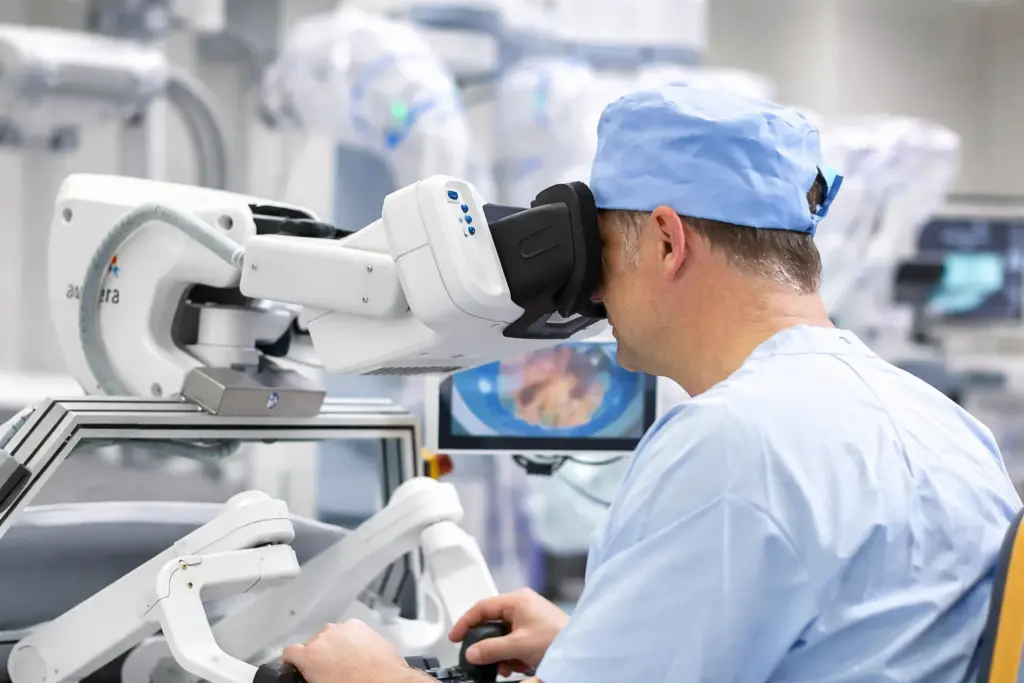
Robotic systems follow the same principle

visible. A movement at the tip of the instrument must remain repeatable, even when actual components vary. Friction, force transmission, vibrations, assembly, maintenance, and the operating environment all interact. A prototype may perform well in the lab but cause problems later in mass production if tolerances, testing concepts, or mass-production processes are considered too late. We prioritize system understanding, verifiability, and production-ready design from the outset.
The study also refers to digital solutions, telemedicine, registry systems, and AI-supported diagnostics. From our perspective, however, their effectiveness does not stem from the software alone. They require robust devices, high-quality data, reliable interfaces, suitable sensor technology, a secure power supply, calibratability, and seamless integration into real-world workflows.
A telemonitoring system is only helpful if the measured values are generated reliably and used in a meaningful way.
A clinical device must function even when shift operations, cleaning, cable routing, connection cycles, and time pressure take their toll on a daily basis.
Late corrections cost money, time, and trust. If requirements remain unclear, interfaces are only roughly described, or system boundaries aren’t properly defined, uncertainty spreads throughout the project. Eventually, it resurfaces in the lab, in the technical documentation, during the approval process, or in series production. This is where MBSE, digital twins, and early verification come into play. Mechanics, electronics, software, risk management, and requirements are not considered in parallel, but rather as a single system.
Our cross-industry perspective, spanning medical technology and device engineering, also supports this approach. Device engineering provides the focus on robustness, costs, thermal management, battery integration, production, assembly, and service. Medical technology provides the rigor in risk management, evidence-based documentation, usability, and regulatory safety. Both go hand in hand when an idea is to be transformed into a system ready for series production. Medium-sized manufacturers, in particular, need development partners who combine technical depth with pragmatism.
The study also shows that cost savings require investment.
New equipment, training, processes, infrastructure, and approvals… Efficiency requires that development, application, and production logic be considered together.
For us, the study demonstrates that medical technology has a positive economic impact when it is developed to a high standard, properly tested, and designed with consistent application in mind. Behind the potential for many billions of euros lie detailed development decisions:
a clean interface,
a stable tolerance chain,
a reliable test bench,
intuitive operation,
a concept suitable for mass production.
This is how medical technology can become a driver of growth. If this topic is currently on the table in your project, we’d be happy to discuss it with you.
Source: Prognos 2025, “Efficiency Potential of Innovations for the Healthcare Sector,” a study commissioned by the Federation of German Industries.