No more tangled cables!
Corded tools are now increasingly becoming the exception on modern construction sites. Cordless battery-powered tools are conquering everyday working life, particularly in the form of powerful 18-volt systems. In this article, we take a look at why 18-volt batteries in particular are becoming the standard, the technical advances behind them (from new cell technologies to turbo charging times), and what this means strategically for manufacturers and users. We also show how B&W can offer added value as your development partner for batteries, charging technology, thermal management, and integration.
In recent years, a clear trend has emerged: most manufacturers are relying on 18-volt batteries as the heart of their cordless platforms. The reason: modern 18-volt technology now achieves a level of performance that previously required 36 volts or more (handwerksblatt.de).
Renowned manufacturers are primarily increasing the possible current flow instead of simply increasing the voltage. This ensures that batteries remain compatible with each other and deliver the same power at 18V that others only achieve at 40V. The advantage for all of us is lighter weight and more compact devices, as a lower voltage level allows for smaller designs. It’s not about the voltage itself, but about the optimal interaction of all components.
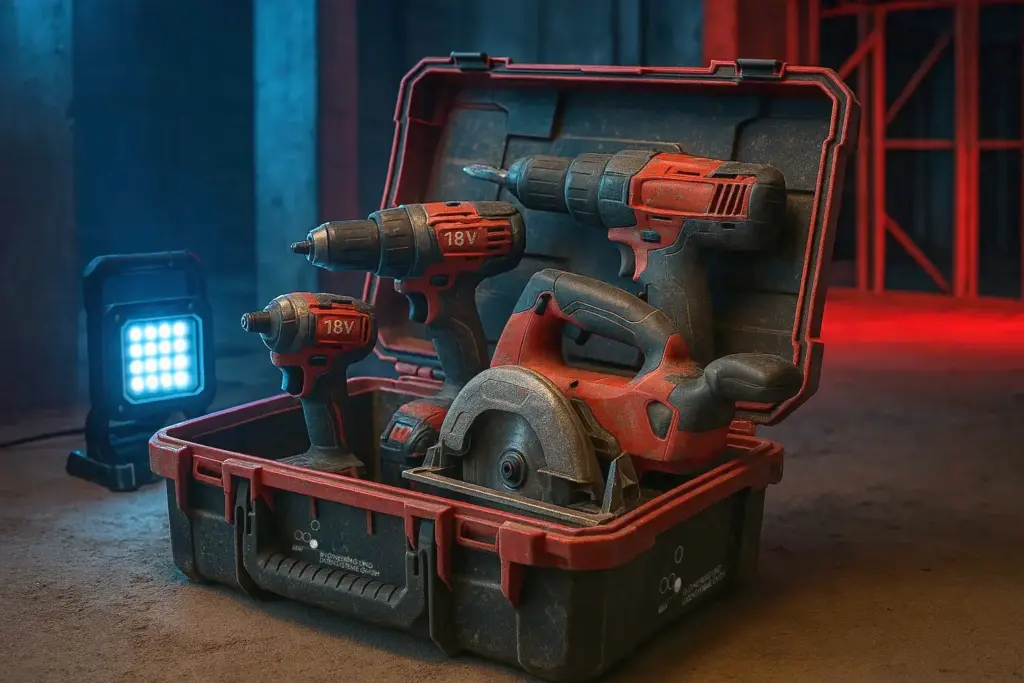
The result is clearly noticeable on the construction site. Cordless tools have caught up in terms of performance! Many cordless professional tools now match the power of their corded 2000-watt counterparts and can even exceed it for short periods. At the same time, they offer the freedom of movement that only cordless tools can provide – no tripping hazards from cables, no need to change sockets. Today’s 18-volt hammer drill or angle grinder is no longer the compromise of earlier days, but often a full-fledged replacement for the mains power supply. Craftsmen can now work a whole day with 18-volt tools – without annoying interruptions and at full power.
Many companies cooperate in cross-manufacturer battery alliances to ensure that a battery fits in machines from different brands. One example is the AmpShare alliance (initiated by Bosch) or the Cordless Alliance System (CAS) from Metabo and partners. For users, this means flexibility and tangible advantages in terms of cost and handling. If every manufacturer were to rely on its own battery system, this would complicate and increase the cost of everyday work.
Thanks to shared battery platforms, however, batteries and devices from many suppliers are compatible. You don’t have to buy new batteries and chargers for every new tool. This saves time, space, and money in operation. Our industry has understood this: standardization to 18 V and cooperation on battery systems increase acceptance and make cordless construction sites economically attractive.
New cell technologies are delivering ever higher power densities and more efficient batteries. Bosch provided an impressive example of this at the end of 2023: they were the first in the world to use the so-called tabless design for 18 V battery cells. This eliminates the classic connection tab in the cell; instead, the current flows through numerous connection points simultaneously. This reduces the internal resistance of each cell by around 50%. The result is significantly less heat generation under load and thus more usable power. In fact, the new battery achieves up to 71% longer runtime with the same capacity! We developers refer to this as thermal management at the cell level. Less internal resistance means less heat and fewer shutdowns, allowing the battery to unleash its full energy potential.
At the same time, chargers are making great strides. Fast-charging technology is the key to keeping wireless devices operational without long breaks. With the right charging system, modern lithium-ion batteries can absorb enough energy in a fraction of a minute to continue working. Some of our customers now have batteries that recharge to 80% in just 35 minutes – twice as fast as the previous generation. Smaller batteries can achieve even shorter charging times. 80% in 12 minutes. If you use two battery packs alternately, you can work virtually without interruption because one is charged before the other runs out.
Of course, it’s not just about speed, but also about service life and safety. Fast charging and high currents place high demands on battery design. This is where advanced battery management systems and cooling concepts come into play: electronics monitor the cells, prevent overheating, and balance the charge optimally. Many batteries have built-in sensors and sophisticated ventilation or heat sinks (CoolPack is a well-known term) for heat dissipation. This maximizes service life, despite ever-increasing performance requirements.
“More power, longer runtimes, faster charging cycles.”
For developers and manufacturers, however, this also means that they must remain up to date in order to remain competitive. Users rightly expect that professional cordless tools will no longer be slowed down by weak batteries or endless charging.
For manufacturers, standardized battery platforms mean economies of scale: instead of having to develop and produce X different battery and charging systems, they can focus on one core platform (as mentioned, usually 18V) and equip various devices with it. This saves development time and costs and simplifies service and logistics. It also promotes customer loyalty—once a customer has decided on a battery system, they prefer to buy devices that are compatible with it. This makes it all the more important for suppliers not to be left behind by this trend.
Global market developments are also exerting pressure, as prices for lithium-ion batteries have fallen to a record low worldwide in 2024 (averaging around $115/kWh) (source: International Economic Forum for Renewable Energy (IWR) / IWR.de GmbH: windbranche.de). On the one hand, this makes batteries cheaper to purchase, which is good for construction site equipment. On the other hand, it puts pressure on battery manufacturers’ margins. Innovation and smart integration are therefore doubly important. They enable companies to set themselves apart from the competition and help to reduce costs (for example, through more efficient manufacturing or more durable products that reduce warranty costs).
“Battery technology is strategically crucial. It directly influences competitiveness in terms of productivity gains, customer satisfaction, and cost structures.”
With all the technical possibilities available, implementation can be a challenge for individual companies. Flexibility is our core value: our customers and partners get exactly the power they need, cleverly integrated and future-oriented.
- We develop battery packs and chargers tailored to your requirements. Whether you want to integrate an existing 18 V ecosystem or build your own system, we find the optimal solution, from cell chemistry and electronics to housing design.
- High-performance batteries operate close to their physical limits. We ensure that heat and stress remain under control. Through simulation and testing (e.g., heat distribution, short-circuit resistance), we ensure that maximum performance is achieved without compromising safety and service life. The central question is always: How do we get the most out of the battery without sacrificing its service life? And we provide the answers in the form of sophisticated engineering.
A battery system is only as good as its integration into the overall product. We take care of the mechanical and electrical integration design. From the precise installation of the battery pack in the device to the interface for data exchange (keyword: networked products). We also take care of standards and approvals so that your battery-powered device complies with all regulations. In short: your projects move forward with a “click,” namely the click with which the battery clicks into the device. This seemingly obvious process requires a great deal of know-how in the background, and that’s exactly where we come in.
We listen, ask questions, and then develop in close collaboration with your team. We adapt to your processes. Whether it’s consulting in the early concept phase, taking over development packages, or joint troubleshooting in an ongoing project: our support is as modular as you need it to be. You don’t have to do everything yourself; instead, you can access our bundled knowledge when and how it makes sense. Together, we turn technical challenges into tangible successes.